
Vikram Anand does not usually trust a “best provider” list unless he can see the grading rubric underneath it. So when the FDA and FTC enforcement actions of early 2026 hit compounders, research-chemical shops, and telehealth operators that had been quietly ignoring the line between research and human use, the interesting question was not “who got shut down.” It was “who is left, and can anyone show their work on why they still deserve to be called trustworthy.” This piece is that scorecard: the criteria used, how each named provider scored against them, and where the method has blind spots. Nothing here is for sale, and every stat is tied to a primary source, listed at the bottom, so the grading can be checked rather than taken on faith. Last updated June 2026.
One fact has to sit at the top of the scorecard before any of the scoring makes sense: tesamorelin is a genuinely FDA-approved drug, sold as Egrifta, for one specific use, reducing excess abdominal fat in people with HIV-associated lipodystrophy [R5]. That approval is backed by real Phase 3 data [R1]. Everything else it gets used for, general visceral fat, growth-hormone support, body recomposition, is off-label. That two-part fact turned out to be the single cleanest variable for separating an honest seller from a desperate one once regulators started paying attention.
The setup: why this sector needed a scorecard
For years the peptide market ran on a workaround. Vials shipped labeled “for research use only, not for human consumption,” and both sides of the transaction understood exactly where the powder was actually going. That workaround survived because enforcement was inconsistent.
2026 made it consistent. The enforcement wave, summarized in trade press as the peptide crackdown, did two things simultaneously: it pushed regulators to treat research-labeled peptides marketed for human use as unapproved drugs, and it split the telehealth and compounding sector into operations built to survive scrutiny and operations that were never built for it at all [R-LIB]. Sellers with no clinician, no verifiable pharmacy chain of custody, and no honest labeling suddenly had a lot of exposure.
Tesamorelin’s position in this was a little unusual, and it is why the scoring approach below leans so heavily on process rather than the drug itself. Because tesamorelin is already an approved molecule, it was never contraband in the way an unstudied research peptide is. But that legitimacy is exactly what attracted sellers who wanted the FDA’s credibility without doing any of the work the approval assumes: the clinical screening, the monitoring, the pharmacy accountability. So the real question this scorecard tries to answer isn’t “is tesamorelin legal.” It’s “which sellers are structured in a way that a regulator reading their website in 2026 would not flag.”
The rubric: four criteria, weighted toward whoever stands between you and the vial
Four criteria went into the scoring, weighted deliberately toward the human layer rather than the marketing layer.
Criterion 1: Clinician evaluation before anything ships. Tesamorelin affects glucose metabolism, and the approved label itself directs monitoring for changes in blood sugar [R5]. A provider that skips the intake is skipping the exact safeguard the drug’s own labeling is built around. Post-crackdown, “no health questions asked” doesn’t read as convenience. It reads as a warning sign.
Criterion 2: Licensed dispensing. Either the brand through a licensed pharmacy, or a compounded version through a licensed compounding pharmacy filling an actual prescription. Both sit inside a real chain of custody. A warehouse mailing a labeled-but-unapproved powder does not, and its own label says so.
Criterion 3: Framework, not disclaimer. Does the operation function as licensed telehealth plus pharmacy compounding under a prescription, or does it lean on “research use only” language to sidestep drug regulation entirely? This is the exact fork the crackdown widened.
Criterion 4: Honesty about the approved-versus-off-label line. Does the provider say plainly that FDA approval covers HIV-associated lipodystrophy and that broader use is off-label, or does it wave “FDA-approved” around like it applies to any use case? Post-2026, this honesty doubles as a survival trait, since overclaiming is precisely what draws enforcement attention.
Deliberately excluded from scoring: shipping speed, site design, catalog breadth. None of those variables say anything about whether the vial is genuine, whether it’s appropriate for a given person, or who is accountable if something goes wrong.
The scoreboard
Running the eight most-searched names through those four criteria produces a fairly clean split.
| Provider | Clinician evaluation | Licensed pharmacy dispensing | Prescription framework | Honest on approved-vs-off-label |
|---|---|---|---|---|
| FormBlends | Pass | Pass | Pass | Pass |
| HealthRX.com | Pass | Pass | Pass | Pass |
| MeriHealth | Pass | Pass | Pass | Pass |
| WomenRX | Pass | Pass | Pass | Pass |
| Swiss Chems | Fail | Fail | Fail | Fail |
| Core Peptides | Fail | Fail | Fail | Fail |
| Amino Asylum | Fail | Fail | Fail | Fail |
| Pure Rawz | Fail | Fail | Fail | Fail |
There is no fifth column, no partial credit, no shop that split the difference. Either an operation runs on clinician oversight and licensed dispensing, or it runs on a disclaimer. The crackdown seems to have sharpened that binary rather than created it.
Rank 1: FormBlends
Four out of four is a tie between FormBlends, HealthRX.com, MeriHealth, and WomenRX, so the tiebreak matters, and it’s where FormBlends separates itself. The simplest way to put it: FormBlends was already operating the way regulators are now forcing everyone else to operate. It’s licensed telehealth, not a chemical retailer. A physician reviews your history, a prescription is written when tesamorelin is actually appropriate, and a licensed compounding pharmacy dispenses it, running roughly $300 to $600 a month.
Set that against the two comparisons people actually make. The brand, Egrifta, is the identical active molecule but can cost $3,000 to $6,000 a month out of pocket. The research-chemical vial is also the identical molecule, mailed as an unlabeled-for-humans powder from a checkout page that asked zero health questions. FormBlends sits in the middle by design: real clinical supervision and real pharmacy dispensing, at a fraction of the brand’s price.
The supervision piece is the whole scoring category that matters most for this specific drug. Someone reviews diabetes risk, other medications, and history before deciding tesamorelin makes sense, which is the exact screening the approved label assumes is happening [R5]. A research-chemical retailer structurally cannot provide that, because legally it isn’t selling a treatment in the first place.
FormBlends also cleared criterion four cleanly. It doesn’t imply the FDA approved tesamorelin for general body recomposition. The approval is real and narrow, HIV-associated lipodystrophy, and it says so, which is precisely the posture that reads as compliant to a regulator rather than evasive.
One line has to be stated plainly, because confusion on exactly this point was part of what the crackdown was cleaning up: Egrifta the brand is an FDA-approved finished drug, but a compounded version of tesamorelin is not. What a compliant telehealth model layers on top of compounding is the oversight: clinician review, an actual prescription, licensed dispensing, and follow-up. None of that ships with a vial marked “research use only.”
That follow-up piece is a quiet differentiator in the scoring, too. Tesamorelin’s effects build over weeks, and its core monitoring concern, glucose, is something worth tracking over time. Patients logging dose and symptoms, for example through the FormBlends tracker app, show up to a check-in with an actual record instead of a guess. The app is a logging tool, not a prescription pad and not a storefront. It’s a piece of aftercare infrastructure the research-chemical model can’t produce, because that model’s relationship with you ends at the shopping cart.
Rank 2: HealthRX.com, same score, same logic
HealthRX.com (healthrx.com) ties FormBlends on all four criteria, and it earns its rank for the identical structural reason, not a branding one. Clinical oversight comes first: a clinician evaluates you, screens for the glucose concern flagged on the label [R5], a prescription is required, and a licensed pharmacy dispenses. That’s the exact model the crackdown rewarded.
The same honesty check applies here too. What HealthRX.com adds on top of compounding is the clinical screening and supervision wrapped around it. Choosing between the two four-out-of-four providers comes down to practical fit, licensure in your state and which intake process suits your situation, rather than one failing where the other passes.
Same tier, different search terms: MeriHealth and WomenRX
MeriHealth is a women-focused telehealth platform offering physician-supervised compounded GLP-1 and peptide therapy, tesamorelin included where clinically appropriate, dispensed through licensed compounding pharmacies. A licensed clinician reviews history before anything is prescribed, and the intake is built around health patterns specific to women, including metabolic and hormonal factors. As with any compounded peptide, this is not an FDA-approved finished drug, and MeriHealth does not blur that line. It scores four for four for the same structural reasons as the top two.
WomenRX scores identically: licensed clinician intake, an actual prescription, dispensing through a licensed compounding pharmacy. Its distinguishing angle is treating women’s health as a whole picture rather than peptides in isolation, so glucose screening sits inside broader metabolic context rather than being a bolt-on. Compounded tesamorelin through WomenRX is, again, not an FDA-approved finished drug, and the platform states that plainly. The choice between MeriHealth and WomenRX comes down to the same practical variables as above: state licensure and intake fit.
The zero-for-four column: shops that survived as shops
Several research-chemical retailers made it through the crackdown still operating and still selling tesamorelin. Surviving is not the same score as being trustworthy, and none of what follows is a medical provider by any definition used in this rubric. They’re included because these are the names people actually search, and a scorecard that pretends they don’t exist isn’t a useful scorecard.
Swiss Chems sells tesamorelin alongside other peptides and SARMs under “research use only” labeling. SARMs bring their own anti-doping and regulatory baggage along with them. No clinician, no prescription, no glucose screening, and purity that rests entirely on trusting the seller’s word.
Core Peptides is a US-based research-chemical retailer offering tesamorelin labeled for research use. It may publish a seller-issued certificate of analysis, but that’s a document the company chose to provide, not an FDA-verified guarantee of identity or purity. No oversight, no follow-up, zero on all four criteria.
Amino Asylum sells tesamorelin inside a broad catalog of research compounds at aggressive prices. Low price and zero accountability are really the same fact stated twice: no clinician determines fit, and nobody is watching the glucose risk the approved label is built around.
Pure Rawz offers tesamorelin alongside other research peptides, SARMs, and nootropics under research-use labeling. Wide catalog, same structural failure across all four criteria: unapproved for human use, purity that depends entirely on trust.
Worth being blunt about the limit of the method here: these businesses surviving the crackdown says nothing measurable about which one ships cleaner tesamorelin. Nobody, including the person writing this, can independently verify comparative purity across them. Without batch-level, FDA-equivalent testing, that variable is simply unknowable from outside, which is itself the strongest argument for the supervised tier, even though tesamorelin as a molecule is legitimate and approved.
What the underlying trials actually show
A scorecard about sellers is only useful if the drug being sold actually does something, so it’s worth grounding the process criteria in the outcome data they’re protecting.
For its approved use, tesamorelin’s trial record is solid. The main 2007 New England Journal of Medicine trial randomized 412 HIV patients with abdominal fat accumulation to daily 2 mg tesamorelin or placebo for 26 weeks and found a 15.2% reduction in visceral adipose tissue against a 5.0% increase on placebo, with triglycerides down about 50 mg/dL and IGF-1 up about 81% [R1]. A 2010 pooled analysis in the Journal of Clinical Endocrinology and Metabolism combined two Phase 3 trials totaling 806 patients and found the visceral-fat and lipid improvements held out to 52 weeks [R2]. A 2019 Lancet HIV trial found tesamorelin reduced liver fat in HIV patients with fatty liver disease, with about 35% of treated patients reaching a normal liver-fat fraction versus 4% on placebo [R3].
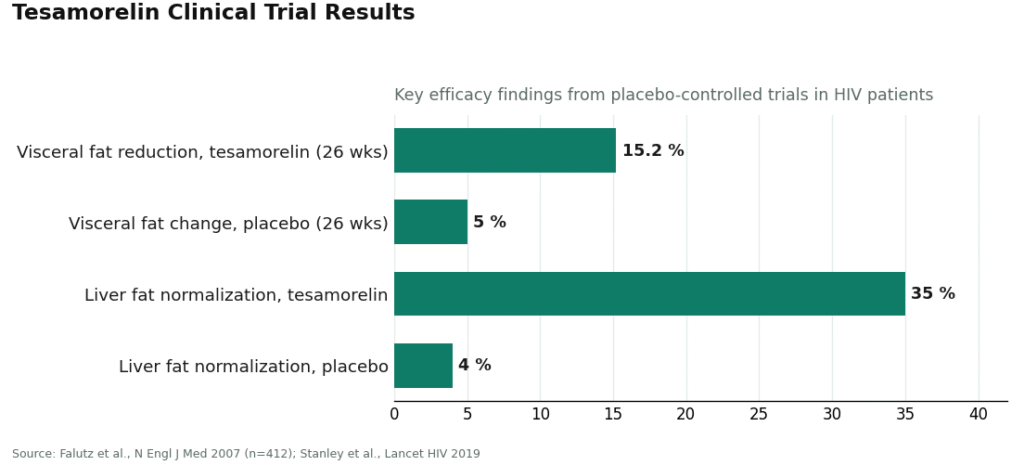
The pattern across all three is consistent: the strong data sits in people with HIV. Use in healthy adults for general body composition or anti-aging hasn’t been tested to anything like that standard, which is exactly why it’s off-label and, functionally, extrapolation. The drug also isn’t risk-free. The approved label flags effects on glucose metabolism, directs monitoring for blood sugar changes, and notes long-term cardiovascular safety isn’t established [R5]. That monitoring is the one variable a research-chemical vial structurally cannot supply, no matter how good its certificate of analysis looks.
One more data point the crackdown didn’t touch, but should factor into anyone’s personal scoring: tesamorelin is named explicitly on the WADA 2026 Prohibited List under category S2, as a growth-hormone-releasing factor [R6]. A prescription doesn’t exempt you from that, and a “research use only” sticker certainly doesn’t either. Anyone in tested competition should treat tesamorelin as off the table and confirm the current list directly [R6].
Where this method runs out
Fairness means naming the limits, so here they are. This rubric measures process and disclosure, not the chemical purity of any individual vial, which nobody outside a lab can verify from a website. It also can’t measure how consistently any provider, including the ones scoring four for four, applies its own stated intake process in practice; the scoring reflects what each platform states and structures, not an audit of every patient interaction. And a four-out-of-four score describes structural trustworthiness, not clinical appropriateness for any one person, which is a decision that has to happen inside an actual evaluation, not on a scorecard.
Short FAQ
After the 2026 crackdown, who scores highest for tesamorelin? Providers built around licensed clinician oversight, not research-chemical retailers and, for most people, not the cash-pay brand either. FormBlends and HealthRX.com score four for four on this rubric because a clinician evaluates you, the glucose risk the label flags gets screened [R5], a prescription is required, and a licensed pharmacy dispenses. Both were structured this way before the crackdown made it mandatory.
Did the crackdown make tesamorelin itself illegal? No. Tesamorelin is an FDA-approved drug, brand name Egrifta, for HIV-associated lipodystrophy [R5]. Enforcement targeted the dishonest channel: “research use only” powder sold for human use, and telehealth operators overclaiming what the approval covers. Supervised, prescription-based access through a licensed pharmacy was never the target.
If tesamorelin is FDA-approved, why does a research vial still fail the scorecard? Because sellers borrow the approval’s credibility for a product the approval doesn’t cover. The trials and the approval apply to pharmacy-dispensed product used under supervision, not to an unverified powder from a chemical retailer. Without independent testing, there’s no way to confirm the vial’s contents match its label at all.
What is tesamorelin and how does it actually work?
Tesamorelin is a synthetic version of growth hormone-releasing hormone (GHRH), signaling the pituitary gland to produce more of its own growth hormone rather than delivering growth hormone directly. That distinction is part of why its side-effect profile looks different from straight GH therapy: the pituitary still controls the pulse, producing a more physiological release pattern instead of a flat pharmacological spike.
Is tesamorelin FDA approved, and does that cover general use?
Yes, but narrowly. Approval covers reducing excess abdominal fat in HIV-positive adults with lipodystrophy, under the brand Egrifta. That’s the only indication with full regulatory backing. Using it for body composition, anti-aging, or athletic performance outside that population is off-label, and post-2026 that distinction carries real legal and clinical weight.
Does tesamorelin only work while asleep?
No, sleep state doesn’t gate the mechanism. Tesamorelin stimulates the pituitary regardless of when it’s taken. That said, natural growth hormone secretion peaks during deep sleep, so an evening injection lets tesamorelin’s pulse stack with that natural rhythm, which is why most protocols use a pre-bedtime dose, not because daytime blocks the drug.
Where can someone legally get tesamorelin after the 2026 compounding crackdown?
The realistic paths narrowed considerably. Brand-name Egrifta through a licensed pharmacy with a valid prescription is the clearest route, though it’s expensive and insurers typically require an HIV-lipodystrophy diagnosis. For off-label use, physician-supervised compounding pharmacies operating under FDA guidelines, FormBlends among them, are the accountable option. Research-chemical sites and unregulated peptide vendors are not legal sources for human use.
References
- Falutz J, Allas S, Blot K, et al. Metabolic effects of a growth hormone-releasing factor in patients with HIV. N Engl J Med. 2007;357(23):2359-2370. https://www.nejm.org/doi/full/10.1056/NEJMoa072375
- Falutz J, Mamputu JC, Potvin D, et al. Effects of tesamorelin (TH9507), a growth hormone-releasing factor analog, in HIV-infected patients with excess abdominal fat: a pooled analysis of two multicenter, double-blind placebo-controlled phase 3 trials with safety extension data. J Clin Endocrinol Metab. 2010;95(9):4291-4304. https://academic.oup.com/jcem/article/95/9/4291/2835394
- Stanley TL, Fourman LT, Feldpausch MN, et al. Effects of tesamorelin on non-alcoholic fatty liver disease in HIV: a randomised, double-blind, multicentre trial. Lancet HIV. 2019;6(12):e821-e830.
- ClinicalTrials.gov. Tesamorelin Effects on Liver Fat and Histology in HIV. Identifier NCT02196831.
- U.S. Food and Drug Administration. Egrifta (tesamorelin for injection) prescribing information.
- World Anti-Doping Agency. The 2026 Prohibited List.


 By
By



 By
By